
Business doors on shops, auto bays, warehouses, RV and boat storage, and ranch buildings out on the plains, from sectional overhead doors to rolling steel. A door that leaves a building open is handled first, and the estimate is free.
Tell us what the door is doing. Free estimate, written down, before the first tool comes out.
A door on a working building does in a month what a house door does in a year. The bay door at an auto shop, the overhead door on a contractor's yard, the row of curtains at an RV storage lot: each one cycles more, carries more weight and gets bumped more than anything on a home.
Wear follows use. Springs reach the end of their cycles sooner, cables stretch and fray, rollers flatten, and the operator that lifts the door day after day runs hotter and longer than a household unit ever will. A repair that ignores how often the door runs tends to be repeated, so that question comes up on every call.
Spring gusts here can hit a wide door hard, and a big shop or warehouse door is a sail when the wind gets behind it. Sections bow, hinges crack along the stiles, and a door caught partway open can be shoved right out of its tracks.
Repairs for wind damage start with the structure: struts across the back of wide sections, hinges and brackets replaced where they've cracked, and tracks braced back to solid framing. A door that has been flexing for years often has loose fasteners along every track, and those get tightened or replaced before the door is trusted again.
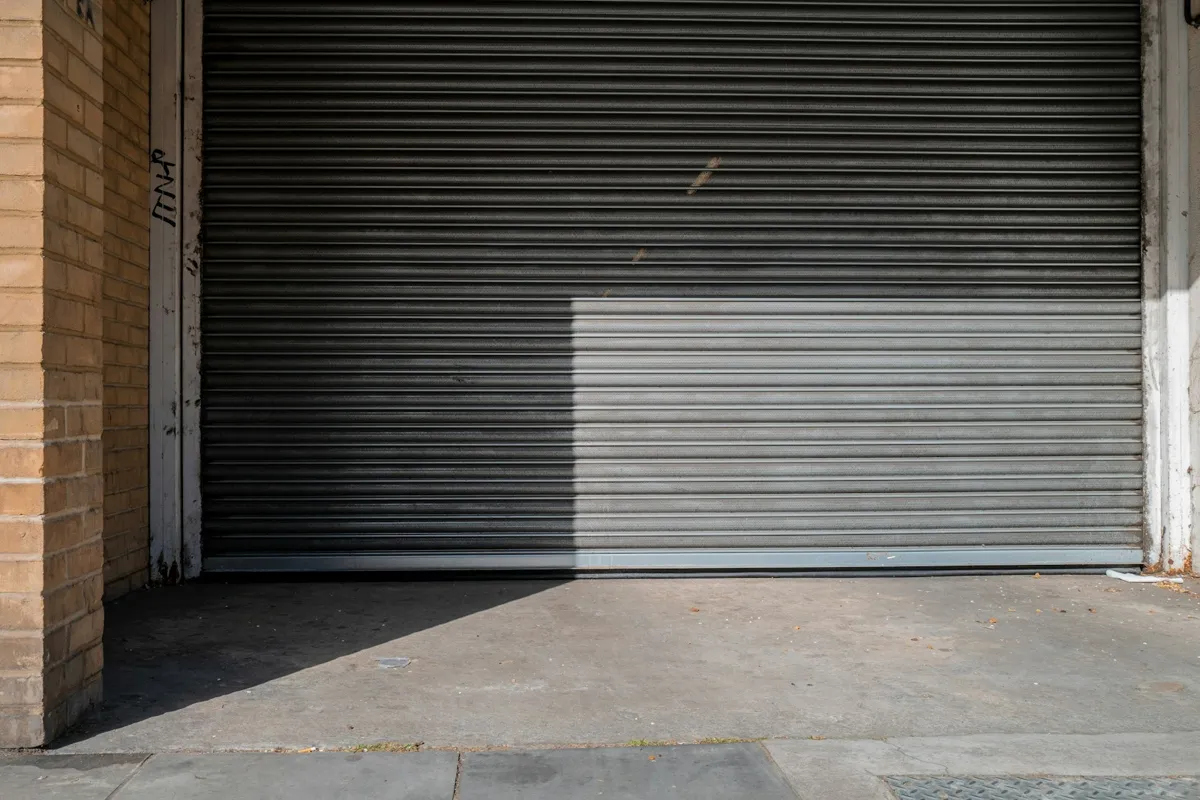
Most shops and auto bays here use sectional overhead doors, panels joined by hinges and riding in tracks, frequently insulated and often with a row of windows for daylight. Warehouses and loading areas lean toward rolling steel, slats coiled on a spring-loaded barrel above the opening.
Storage lots use the lightweight corrugated curtains that roll up into a drum, often by the dozen along one building. Each design wears differently, and the parts are not interchangeable, so the first thing on a call is what kind of door it is, how big it is, and what it's doing when someone tries to run it.
The wind that bends doors also loads them with fine dust. It packs into the guides of rolling doors, grinds at slat ends and coats the rubber on the bottom bar until it no longer seals. On sectional doors it gets into rollers and bearings, and the door starts to shudder and drag.
Cleaning the old grease and grit out before anything new goes on is part of every commercial visit here, since fresh lubricant on top of old paste only grinds faster. Worn rollers, damaged slat ends and cracked bottom rubber are replaced, and the operator's force is set back to what a free-running door needs.
Out on the plains, the doors on equipment buildings and barns are often the tallest in the county, and some go unopened for weeks at a time. When they finally move, a spring that has been sitting under tension through a hot summer and a sharp freeze is the part most likely to give.
Tall doors need cables long enough for the full run, drums matched to the height, and springs sized for a heavier door than anything on a house. Sliding doors on older barns hang from rollers on an overhead rail, and those rollers, hangers and guides wear out too. Both kinds are repaired on site, with the parts for a tall run brought along once the door's size is known.
Whether it's one bay or a whole storage row, the work follows these steps.
A door that won't come down at closing time leaves tools, stock and vehicles exposed, and that call goes ahead of scheduled work. The visit aims for a secure building first; if the complete repair depends on something that must be ordered, the door is closed, locked and made safe in the meantime.
The reverse problem matters just as much: a door that won't open in the morning keeps trucks in and customers out. Both are urgent, and both get a straight account of what failed and what it takes to put right.
Commercial operators hang from the ceiling on a rail, bolt to the wall beside the door and turn the spring shaft, or sit beside the barrel of a rolling door with a hand chain for outages. Push-button stations, key switches and remote controls run them, and many doors carry a reversing edge along the bottom bar as well as photo eyes.
Heat in a closed metal building is hard on all of it. Operators trip their overload on long hot runs, control boards age, and edge cords crack. When a door works in the morning and quits by afternoon, heat and a dragging door are the first suspects, and both are checked before any operator is replaced.
Doors still raised by chain can usually take a motor, with the springs balanced first so the new operator isn't working against dead weight.
Sectional overhead doors, rolling steel doors and the roll-up curtains used at storage lots, along with their springs, cables, guides, sections, seals and operators.
Usually. Bent sections can often be replaced individually, cracked hinges and brackets renewed, and the tracks braced back to solid framing. Struts are added on wide doors that lack them.
Yes. A door that keeps a business from opening, or a building from closing, goes ahead of routine work.
Yes. Tall doors on equipment buildings and barns are repaired with springs and cables sized for their height and weight.
Usually, yes. The barrel springs are balanced first so the motor isn't straining, and the chain stays on the door for power outages.
Yes. Several doors are handled on the same visit, and each door's repairs appear on their own line of the estimate.
Long runs in a hot building can trip its overload, and a door dragging with grit makes it work harder. Both the operator and the door are checked.
It is. Someone looks the door over, explains the problem in plain words, and writes a free estimate before any work begins.
Describe it and you'll hear an honest opinion on whether it's a today job or not. Free estimate wherever you are.
Would rather call? Call (719) 662-8141.
Tell us what the door is doing. Free estimate, written down, before the first tool comes out.