
Automatic gates that stick halfway, drag, grind or won't close, repaired along with the operators, batteries and keypads behind them. Out on the big lots, heat and grit do most of the damage. Most repairs finish in one visit, and the estimate is written down and free.
Tell us what the door is doing. Free estimate, written down, before the first tool comes out.
Swing gates on straight or folding arms, sliders on a ground track or cantilever rollers, and the operators, batteries, solar panels, keypads and loops that make them automatic. If a gate on your drive has gone sluggish, stopped partway, begun to droop or started grinding, you're on the right page.
Most of the gates we see sit at the end of long gravel drives on the big western lots, often on solar because trenching power out to the road is a big job. Closer in, sliders across driveways and ornamental swing gates in front of brick ranches are common.
Either way the same short list of parts wears out, and those parts ride on the truck.
Shops and pole buildings on the bigger properties often have their own gate to the back lot, with a second operator that gets used less and ages differently.
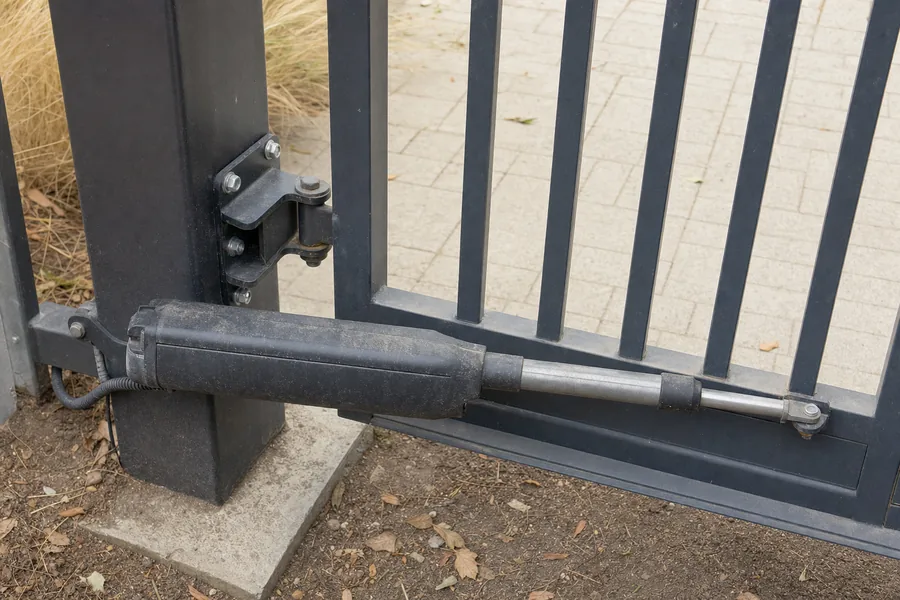
Nearly every gate call traces back to one of these, and they're checked in about this order before anyone blames the operator:
Picture a pair of steel leaves hanging off two posts, day and night. Once a hinge wears or a post tips, the leaf sinks at the latch end, rubs the drive and binds, and the operator strains a little harder on every trip until a gear, an arm or the motor gives up. The heavier the leaf, the sooner it happens.
Sliding gates have their own version. Gravel works into the channel, a roller bearing seizes with grit, or the concrete under the track lifts a little each winter, and what used to roll with one finger now takes a shove. Clear and repair the track and the operator stops struggling.
The same idea as a garage door visit, with extra time spent on the gate before anyone opens the operator box. Mention anything that changed recently, like a new fence or fresh paving.
Summer does most of the damage here. Heat shortens battery and capacitor life, a solar panel filmed with dust charges far less than a clean one, and the wind packs grit into hinges, tracks and eyes. Then the first hard freeze stiffens everything overnight.
Ground movement adds a slower problem. Posts and loops in soil that swells and dries out shift over the years, and a gate that hung straight when it went in can end up dragging.
Gravel drives on the big lots speed all of this up: stones in the track, dust on the eyes, and grit in every moving part.
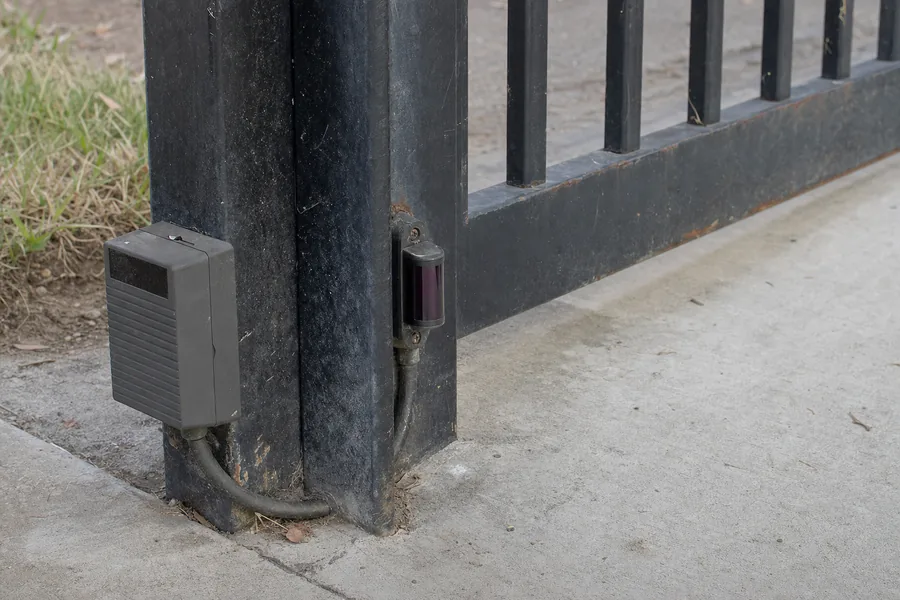
If it still runs, its board can still be bought, and it's rated for the gate, it stays. Most operator failures come down to one part, and replacing that part buys years. Parts availability decides a lot, and you hear what's available first.
A new operator is sized to the real gate, not the brochure. Where there's no power at the post, a solar unit with a panel sized for short winter days is the usual pick.
It goes in only after the gate swings or slides freely by hand, because a new operator on a binding gate fails the same way the old one did.
A gate that answers the keypad and ignores the remote has a receiver or remote fault. A gate that won't let cars out has a loop fault. Those two clues narrow the search before any tool comes out.
We program remotes and keypads, replace receivers, repair intercoms and phone entry, and fix or recut loops.
Keypads at the road face the full sun all day; their buttons stiffen, split and lose their numbers, so replacing one is routine on a gate visit here.
A few details help: any lights on the operator box, sun or house power, the sound it makes when you try it, and which position it's stuck in. That tells us which parts to bring.
Pushing a gate against its own arm is the quickest way to turn a small repair into a big one: the arm bends and the gears strip. If it's stuck, let it sit and call.
Mighty Mule, Ghost Controls and LiftMaster on most home gates, with US Automatic, Viking, DoorKing, Elite, FAAC, GTO, Linear and Nice Apollo on the rest. Common parts for all of them travel with us. A photo of the label settles anything unusual.
Once the gate is proven free by hand, attention shifts to the box: the motor and its capacitor, the circuit board, the battery and charger, and the safety inputs. Testing each with a meter points to the culprit, and the common culprits are replaced on the spot.
Both, along with their operators: swing gates on straight or folding arms, sliders on ground tracks or cantilever rollers. Sliders on cantilever rollers keep the track out of the gravel entirely, which suits dusty drives.
Nearly always a safety device. A photo eye coated in grit or knocked off line reports an obstruction, and the operator holds the gate open to be safe. The eye is cleaned, lined up again, or replaced, never bypassed.
Usually. Batteries, boards, eyes, receivers, arms and chains for the common brands are on the truck, and if something needs ordering you hear it before we leave. Most calls finish the same day.
Yes. Tell us when you call, and the gate is closed and secured before the technician leaves, even if a part has to be ordered.
Usually. A sound motor and an available board mean a repair gives years more. A burned-out motor on a discontinued brand is where a new one makes sense. Parts on hand decide a lot.
Yes, if it's a metal gate that moves freely by hand on solid posts. Both are checked first. If the post is far from power, solar is usually the answer.
Yes: remotes, keypads, receivers, intercoms and phone entry, plus the loops in the drive. Most are done the same day.
One call gets a two-hour arrival window, and the technician calls from the road. You deal directly with us, not a lead service, and nobody guesses at a gate over the phone.
The estimate is written down and free.
A two-hour window instead of a lost day, and a call before the technician arrives. Free anywhere in the county.
Would rather call? Call (719) 662-8141.
Swing or slide, solar or wired. Estimates are free and written down.