
When the gate operator hums without moving, runs out of steam by evening, stops short or ignores the remote, one part has usually failed. Solar, battery and wired, swing and slide, most are repaired right on the drive. The estimate is written down and free.
Tell us what the door is doing. Free estimate, written down, before the first tool comes out.
An operator is a small outdoor machine: motor and gearbox, circuit board, power source, and the safety devices and controls that plug into it. Here it spends summers in serious heat and winters in hard freezes, with wind-blown grit the whole year round. Most of the time just one part inside has failed.
We work on straight-arm and folding-arm swing operators, chain and rack sliders, underground swing units, and solar, battery and hardwired setups, and most repairs are finished in one visit.
Big western lots mean long drives and gates far from the house, so a lot of what we see runs on solar, and batteries and panels are the first things checked.
Shop and back-lot gates on bigger properties often run a second operator that ages differently from the main one.
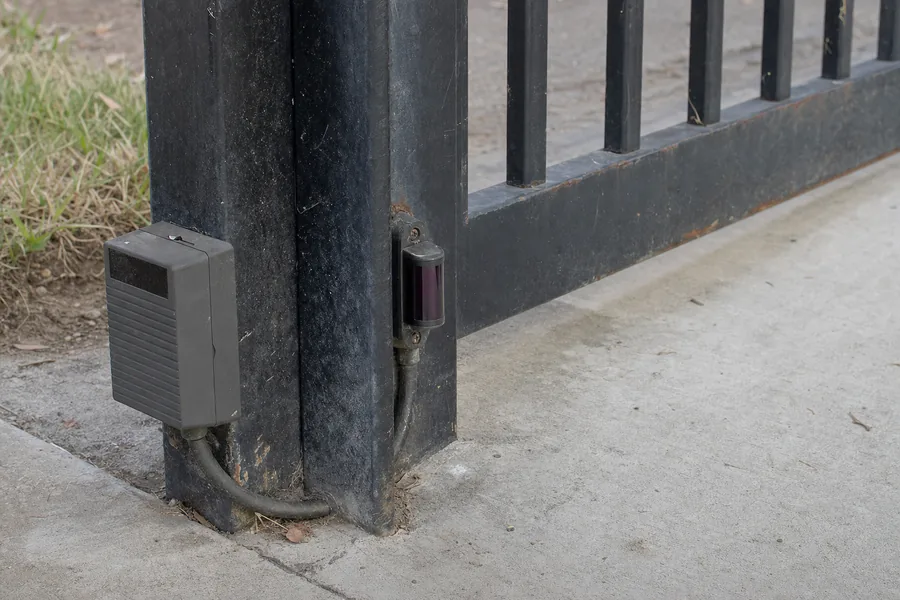
The failures, roughly from most to least common:
On a long drive, solar is usually the power source: a panel on the post trickles charge into a battery, and the battery runs the motor. Batteries lose capacity every summer in this heat, so a solar gate manages fewer trips each year until a short winter day is enough to leave it flat.
Wired operators run from house power through a transformer, and the weak spot is the low-voltage cable out to the gate, which shovels, rodents and years underground eventually damage.
A panel that has picked up a film of dust, or a tree that has grown into its sunlight, cuts charging without anyone noticing. Cleaning and checking the panel is part of every solar call.
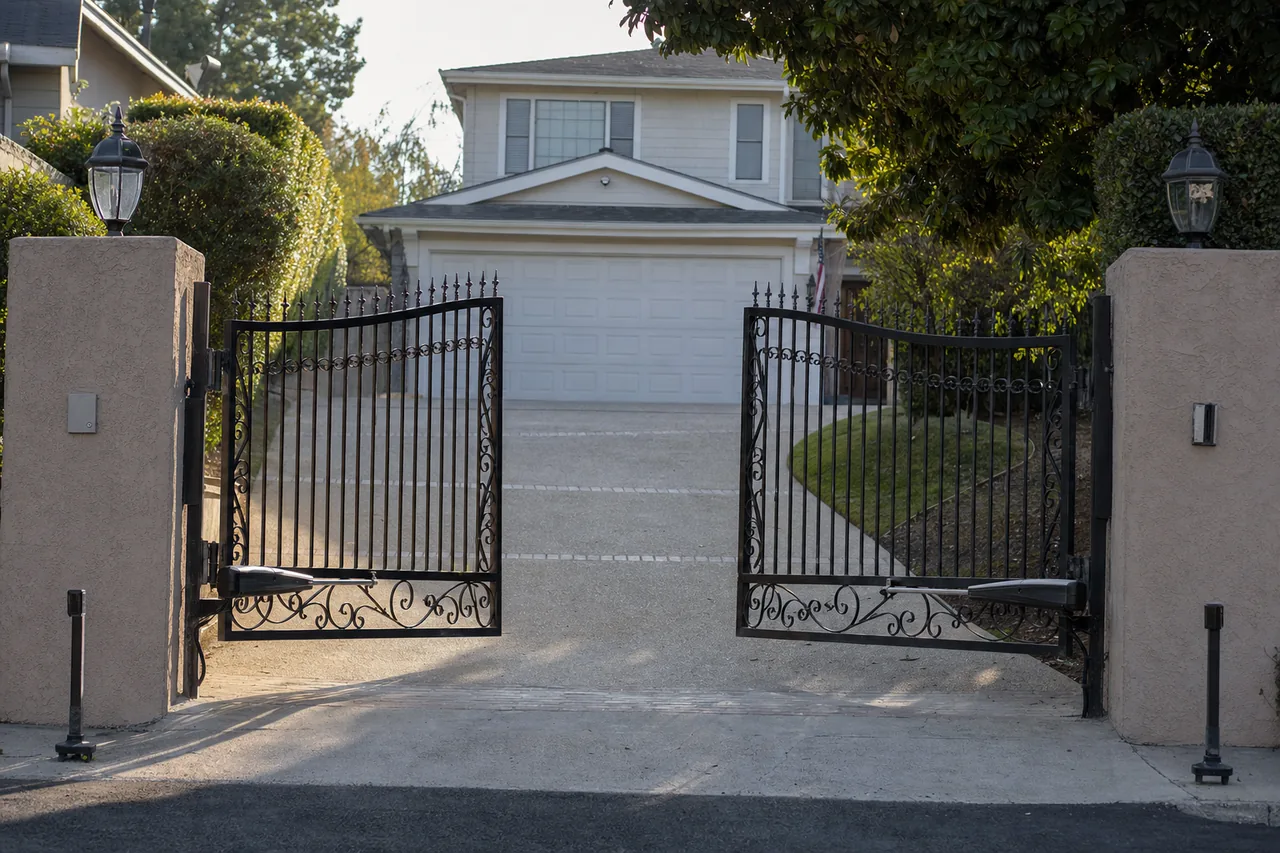
Straight-arm and folding-arm swing units, arms for gates hung inside their pillars, underground swing operators, chain and rack sliders, and heavier commercial operators on shop and ranch gates. All of them get the same diagnostic routine.
Pairs of gates need their two arms to agree on timing. Get it wrong and the leaves bang together or the latch never catches, so the delay between them gets set as part of the repair. Both arms are checked together.
The open-but-won't-close complaint nearly always traces to something the operator is told to respect: an eye that can't see across the drive, an edge that's been crushed, or a loop reporting a car that isn't there.
It errs toward keeping the gate open on purpose. The fix is repairing whichever device is sending the warning, and we don't unhook safety devices to make a gate close. If a device keeps failing, the reason gets found, whether a sprinkler, a trailer hitch or a shifted post.
The same five checks on every operator, because different faults can look identical from the driveway. The order matters: it keeps anyone from replacing a board that was never the problem.
Remotes, keypads, exit wands, intercoms, phone entry and apps all connect to the same inputs on the board, so a control fault is traced from the board out to each device.
Nothing is marked finished until every way of opening the gate has been tried: remotes from the road, the keypad, the exit loop with a car, and any emergency access device. Remotes get tried from the road, not just beside the post.
Most fixes are a single part: a battery, a board, a capacitor, a limit switch, an eye, a receiver or a keypad. We carry them for the popular brands. If something has to be ordered, you hear it before we leave.
A new operator only makes sense on a gate that already moves easily by hand, so hinges, rollers and posts come first. A sagging leaf or a jammed slider gets fixed first.
Summer heat bakes batteries and capacitors and cooks boards inside dark housings. Wind packs grit into tracks, hinges and eyes. Then the first hard freeze stiffens grease and arms overnight, and gates that limped through summer quit. Seals on the housing get checked too, since grit gets in wherever they've cracked.
Our busiest operator months are easy to predict. July and August bring dead batteries and blown capacitors, windy spells bring gritty eyes and jammed tracks, and the first cold snap brings stiff arms and gates that won't finish their travel. The truck is loaded accordingly.
Ground movement is the slow one: posts and loops shift over the years, and a gate that was hung true can end up dragging.
Mighty Mule, Ghost Controls and LiftMaster on most home gates here, with US Automatic, Viking, DoorKing, FAAC, Eagle, Elite and Nice Apollo on older and heavier installs. Parts for the common ones travel with us. A photo of the label helps with anything older.
Any light on the operator, solar or wired, whether the panel is dusty or shaded, and whether it hums, clicks or stays silent. That tells us what to bring. Tell us if a storm came through just before it stopped.
Please keep the covers on and the safety devices connected. The rest is our job. If a car is trapped, say that first.
Seldom. It's usually a safety device: an eye coated in grit or knocked out of line, a damaged edge, or a loop fault. Each is tested separately. Beams get cleaned and lined up again on the visit.
Yes: battery, charge controller, panel and wiring. Most solar calls turn out to be a worn battery or a dirty or shaded panel. Panels get cleaned and checked for shade.
Mighty Mule, Ghost Controls, LiftMaster, Chamberlain, US Automatic, Viking, DoorKing, FAAC, Eagle, Elite, Nice Apollo and most others. A photo of the label helps with rare ones.
No. A gate closing without its safety devices can trap a car or a person, so we repair the devices. It's usually faster to fix the device anyway.
Usually. Batteries, boards, capacitors, eyes, receivers and keypads for the common brands are on the truck. A gate stuck open moves up the day's list.
Yes, and it's written down. You hear the diagnosis and the plan before any work. Shop and back-lot gates can go on the same estimate.
Both, on the same visit if needed. This page covers the operator; the gate's hinges, rollers and posts are covered on our gate repair page. Most visits end up covering both.
One call gets a two-hour arrival window, and the technician calls from the road. You deal directly with us, not a lead service, and nobody guesses at a gate over the phone.
The estimate is written down and free.
A two-hour window instead of a lost day, and a call before the technician arrives. Free anywhere in the county.
Would rather call? Call (719) 662-8141.
Solar or wired, and what it does now. Estimates are free and written down.